
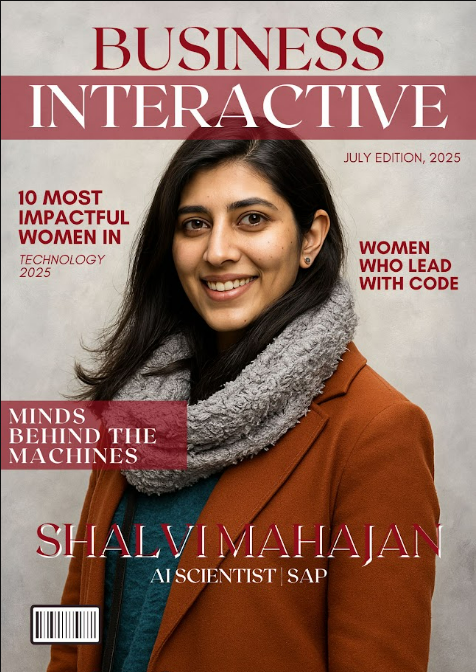

Shalvi Mahajan — Building Empathy and Insight at the Edge of AI
AI Scientist, SAP SE — a journey from small town India to shaping ethical, human-centered AI in the enterprise.
It’s a Tuesday morning in Munich. Sunlight filters in through the high windows of the SAP lab, casting long shadows over whiteboards filled with sketches of neural networks, embeddings, and workflows. Amid the hum of servers and quiet clatter of keyboard keys, Shalvi Mahajan leans back for a moment. She is thinking, not about the perfect model, but about why her latest project — something about bias in natural language translation — might help someone feel seen or prevent someone’s voice from being mistakenly silenced.
That impulse — to see, to listen, to preserve dignity — is what has shaped Shalvi’s path. Her title is “AI Scientist,” but what she really does is hold a mirror to how machines understand people, and try to make that understanding kinder, more precise, more human.
Early Journey & Foundations
Shalvi grew up far from the tech labs of Europe, in a small town in Himachal Pradesh. Even in school, computers captivated her. She went to Delhi Public School, Jhakri, where she discovered early that problems involving logic, pattern, and creativity spoke to her more than rote memorization. Her parents saw this spark, encouraged it, and set a stage where curiosity could thrive even when resources were modest. PrimeView, in a profile piece, notes how Shalvi often thinks back on those years — on evenings spent debugging small programs, or reading about algorithms while everyone else was busy elsewhere.
With that foundation, she went on to the National Institute of Technology Hamirpur to study Computer Science & Engineering. Even before graduation, she was chasing the intersection of math, code, and real-world impact. One early summer internship at École Eurêcom in Sophia Antipolis, France, had her analysing telephone fraud data — that was the first time she saw how what seems like dry data could map to human misdeeds, and how detection could mean justice or fairness.
After her bachelor’s, Shalvi joined Samsung R&D in Delhi as a Software Development Engineer, writing code, building systems and solving immediate bugs. But she realized that the problems she wanted to solve were bigger: models, bias, trust, human interpretation. That led her to Europe for her Master’s in Data Engineering & Analytics. During those years, she worked at Allianz Technology SE, gathering experience in ML and working with unstructured data, understanding both business constraints and data complexity. In October 2020 she joined SAP SE, first as Data Scientist, then progressing to Senior Data Scientist in the Cloud ERP AI Incubation team in Munich.
The Role of Machine Learning & Why Bias Matters
At SAP, Shalvi’s work is often about bringing structure to ambiguity: natural language, unstructured text, models that learn from millions of words. She loves coding like a developer, she says in interviews — not just in abstract model formulation, but hands-on work: cleaning data, writing the pipelines, refining features.
One of her speaking topics, at Big Data Conference Europe, zeroed in on gender bias in AI. She pointed out how even widely used tools, like translation systems, often misrepresent gender: assuming “nurse” is female, “doctor” male, purely because of historical bias in training data. These are not just abstract problems for Shalvi. She sees them as “small inequities that accumulate” — affecting how people are represented, how they are treated, how they feel in systems built on AI.
She also works with Natural Language Understanding (NLU) and Natural Language Inference (NLI): subfields of NLP that go beyond pattern matching or statistics into understanding meaning, intent, context. In her Women in Tech Global Conference talks, she explains how distinguishing intent or meaning across languages, cultures, and sensitive social contexts is less about computing power and more about the data, the bias, and the care with which models are trained.
Professional Identity & Passion Projects
Today, Shalvi holds the title Senior Data Scientist in SAP’s Cloud ERP AI Incubation team, based in Munich. She’s driven by a love for building, saying she “enjoys coding like a developer” even as she explores intricate mathematical and business challenges with AI. Beyond product work, she stays connected to the tech community—speaking at conferences, mentoring through WomenTech groups, and tackling personal side projects, all while continually aiming to “contribute to society with every bit we do”.
What Success Looks Like to Her
Shalvi defines success not by flashy headlines or big funding rounds, but by tangible, positive change — in her team, in the tools she builds and in how people engage with them. In her “Speaker Spotlight” interview with Data Science Festival, she said that success is having a portfolio of meaningful projects: ones that solve real-world issues, not merely theoretical ones; ones where machine learning doesn’t just run, but delivers insights people can act on. She speaks of recognition — from peers or conferences — as helpful but secondary. The heart of her work is in clarity: models that are interpretable, data that is clean, assumptions that are explicit, and tools that people trust.
She also judges success by the human side. Mentoring others, contributing to conversations about equity and awareness, especially for women and underrepresented people in tech, are central to her sense of progress. PrimeView’s “Redefining Leadership” profile quotes her urging up-and-coming female leaders: speak up even when you doubt, understand the gaps you might face, and find courage in moving forward.
The Daily Balancing Act: Joys & Frustrations
Shalvi’s love for AI comes with its paradoxes. One of the things she loves most is how often she’s learning — new algorithms, new tools, new data challenges. She gets a thrill when late-night debugging yields an insight; when she can pull predictive value from a messy dataset; when she can make a model not just accurate but fair. Working in conferences, speaking at events, being part of communities gives her perspective — people whose paths intersect technology, ethics, business and identity all at once.
At the same time, there are things she finds draining. Much of her time is absorbed by what most outsiders don’t see: cleaning data, defining problem statements (which are often vague at first), dealing with legacy systems, handling constraints of privacy, legality, deployment, and translating “what business needs” to “what data can deliver.” She notes that seeing a prototype model is satisfying — but seeing its impact in the business (or for end users) can require patience. In short, the work is technical and human.
Beyond the Code: Mentoring, Travel & Voice
When she’s not writing code or preparing a talk, Shalvi recharges by travelling. She’s either planning a trip or returning from one. She’s a frequent speaker at international forums and believes that visibility matters: not for ego, but for shaping the narrative of who gets to lead in AI. In mentoring circles and Women in Tech programs, she pushes others to ask for what they deserve, to not shrink in face of bias or silence. In PrimeView’s portrait, she recalls how coming from a small town meant challenges she didn’t always anticipate — cultural expectations, resource constraints, sometimes being dismissed — but also gave her resilience and empathy.
She sees her voice as part of her role. Whether on stage discussing NLU, or in internal SAP workshops, or writing about ML ethics, she wants to contribute to how the field understands itself: not just as tools or models, but as systems that touch people’s lives.
Looking Ahead: Innovations, Responsibility, Impact
Shalvi’s vision for the future is expansive yet grounded. She anticipates that generative AI, prompt engineering, and large language models (LLMs) will increasingly infiltrate business and personal applications, demanding better frameworks for safety, fairness, and explainability. She predicts tighter regulation around AI, more emphasis on responsible AI, and a growing demand for sustainable, ethical practices in how ML systems are built and deployed. At SAP, she hopes to grow not just in technical depth, but in leadership: guiding projects that combine domain knowledge, business insight and ethical guardrails, mentoring young data scientists, speaking more globally and contributing to tools that are not just powerful, but trustworthy. The work, she believes, should straddle math, statistics, engineering and human values.
Struggle, Resilience & What Drives Her Forward
Shalvi’s story is not without struggle. Being in tech as a woman — especially coming from a small town — has brought its share of doubt. Early in her career, she felt the tension of not always being seen; sometimes being the only person who looked or sounded like her in a room. She has spoken about how cultural expectations sometimes meant she needed to be particularly vocal about learning, asking questions, or staking her claim. But those very obstacles gave her perspective: she learned that empathy is grounded in experience, and that sometimes, the most important contribution is letting someone else know they are not alone.
Her resilience shows in how she approaches messy datasets, unclear problem statements, or models that perform well in the lab but flounder in deployment. Instead of blaming, she brings curiosity. Instead of frustration, she leans into asking, “What assumptions are baked in? What voices are missing? How will this model be used, and by whom?”
Conclusion : A Message to the Next Generation
If you are starting out in AI, Shalvi’s advice is both simple and profound: first, master the fundamentals. Learn how algorithms work, understand data, learn programming, understand statistics. But alongside that, keep your eyes on the world: how problems look from the other side of the screen. Seek out mentors. Ask questions. Don’t accept bias or opacity as normal. Speak up, even when it feels risky. And never stop letting your curiosity and empathy guide what you build.
What Shalvi does is build bridges: between data and people; between math and meaning; between power and responsibility. She is part of a growing wave of AI scientists who see that performance metrics are not enough — that what matters is what happens when real people encounter the systems that others build.